
 русский
 简体中文
简体中文

Cryogenic ball valves are widely used in systems that handle very low temperature fluids, especially in gas processing, LNG transportation, storage terminals, and other industrial pipelines where temperature conditions can shift dramatically during operation. In these environments, one physical behavior becomes especially important: thermal contraction.
Instead of treating it as a minor detail, engineers usually consider it early in the design stage because it affects sealing behavior, internal movement, and long-term mechanical stability. The way a valve responds to this condition often determines how smoothly it performs inside a real system over time.
What thermal contraction means in real industrial use
When a material is exposed to low temperature, its structure becomes more compact. In simple terms, it slightly shrinks. In cryogenic pipelines, this happens repeatedly as systems cool down, operate, and warm up again during maintenance or shutdown cycles.
What makes this important is not the change itself, but the fact that different parts of a system do not react in the same way. A valve body, sealing element, stem, and pipeline connection may all respond differently depending on their material type and structure.
In practice, this means a cryogenic ball valve is always operating in a condition where small internal movements are expected.
Why designers treat movement as part of normal operation
In traditional room-temperature systems, components are often designed to stay as stable as possible. Cryogenic environments are different. Stability is still important, but controlled movement becomes part of the design logic.
If contraction is ignored, several practical issues may appear over time:
These effects are not always immediate. They may develop slowly after repeated temperature cycles, which is why design decisions focus on long-term behavior rather than short-term performance.
Structural thinking behind cryogenic ball valve design
Cryogenic ball valves are not built as completely rigid systems. Instead, they are structured to tolerate small dimensional changes while maintaining functional alignment.
In many designs, internal parts are arranged in a way that allows limited adjustment during temperature shifts. This does not mean loose movement, but rather controlled flexibility within a defined range.
Common structural approaches include:
Each of these elements works together rather than independently. The idea is to keep the valve functional even when the surrounding environment is changing.
Material behavior and its influence on contraction response
Material selection plays a central role in how a valve reacts to low temperature conditions. Different metals and sealing materials do not behave in the same way when exposed to cryogenic environments.
Instead of focusing only on strength or hardness, engineers often consider how predictable a material behaves under temperature variation.
General material behavior in cryogenic service conditions
| Material category | Typical response in low temperature conditions | Common role in valve structure |
|---|---|---|
| Austenitic stainless steel | Stable structure with controlled dimensional change | Main body and structural parts |
| Low temperature alloys | Balanced mechanical response under thermal variation | Support and connection components |
| Elastomer sealing materials | Behavior depends on formulation and application design | Sealing and contact surfaces |
| Non-metallic fillers | Used for specific sealing or insulation purposes | Auxiliary sealing elements |
Extended stem structure and thermal isolation
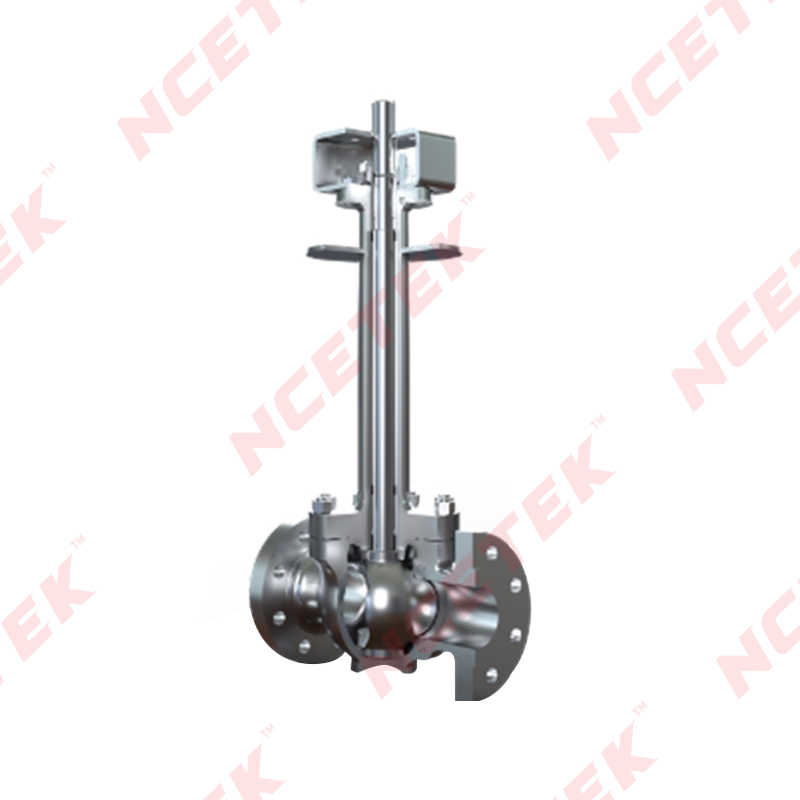
One common feature in cryogenic ball valve design is the extended stem. At first glance, it may look like a simple extension of the control shaft, but its role is more functional than visual.
In low temperature systems, the valve body is exposed directly to the flowing medium, while the actuator is usually located in a warmer external environment. Without separation, temperature transfer could affect mechanical operation.
The extended stem helps create a distance between these zones. This reduces direct thermal influence on external control parts and supports smoother operation during temperature changes.
In real use, this structure helps maintain more consistent movement when the system transitions between different operating states.
Sealing behavior under changing dimensions
Sealing performance is one of the most sensitive aspects of cryogenic valve operation. Even small dimensional changes can influence contact behavior between sealing surfaces.
In cryogenic conditions, sealing design is usually focused on maintaining consistent contact rather than relying on rigid pressure alone.
Common design approaches include:
Internal movement and controlled adjustment
Some cryogenic ball valve designs allow internal components to adjust slightly during operation. This is not uncontrolled movement but a controlled response space.
When thermal contraction occurs, small adjustments help maintain alignment between rotating parts and sealing surfaces. Without this flexibility, internal stress could accumulate over repeated cycles.
In practice, this approach helps the valve maintain stable rotation behavior even after long-term exposure to low temperature environments.
Temperature zones inside valve structure
A cryogenic ball valve is not exposed to a single uniform temperature. Instead, it contains different zones with varying thermal conditions.
Typical internal zones include:
Each zone responds differently to temperature changes. As a result, contraction does not occur evenly across the entire structure.
Designing with this gradient in mind helps reduce stress concentration and supports smoother overall behavior.
Real operation under repeated thermal cycles
In many industrial systems, cryogenic valves do not operate in a single steady condition. They often experience repeated cooling and warming cycles depending on production schedules and maintenance routines.
Each cycle introduces small expansion and contraction movements. Over time, these repeated changes can influence mechanical alignment if not properly managed.
To address this, design considerations often focus on:
These aspects are evaluated as part of long-term usage behavior rather than short-term performance.
Installation influence on thermal behavior
Even with well-structured valve design, installation conditions play a role in how thermal contraction behaves in practice.
Pipe alignment, support spacing, and external mechanical load distribution all influence how forces are transferred during temperature changes.
If installation is not properly balanced, additional stress may appear at connection points during contraction cycles. On the other hand, well-aligned systems allow more even distribution of movement.
This is why installation practices in cryogenic systems often emphasize mechanical stability and controlled support structure.
Maintenance perspective in cryogenic systems
Over time, repeated exposure to low temperature environments may influence how components interact. Maintenance checks are usually focused on observing changes in movement behavior and sealing consistency.
Common inspection points include:
These checks help ensure that contraction effects remain within expected operational behavior.
System level coordination
Cryogenic ball valves are part of larger systems that include pipelines, compressors, storage units, and transfer equipment. In such environments, thermal contraction is not isolated to a single component.
Instead, it becomes a system-wide behavior. The valve must therefore function in coordination with surrounding structures rather than independently.
This system-level perspective is important in understanding why design focuses on adaptability rather than rigidity.
Practical engineering perspective
From a practical engineering viewpoint, thermal contraction is not treated as something to eliminate. It is considered a natural condition that must be managed through design coordination.
Cryogenic ball valve design generally focuses on balancing:
Rather than relying on a single solution, multiple design features work together to maintain stable operation.
Thermal contraction is an unavoidable physical response in cryogenic environments, and it plays a significant role in how ball valve systems are designed and used in real industrial applications.
Through a combination of structural adaptation, material selection, controlled movement design, and system-level coordination, cryogenic ball valves are able to maintain stable operation under repeated low temperature conditions.
The key idea is not to resist contraction completely, but to manage it in a controlled and predictable way. This approach allows the valve to remain functional within complex industrial systems where temperature changes are part of normal operating conditions.
 nce@cnnsv.com
 +86-15727968392 / +86-15397375798
 +86-577-67091815
 +86-577-67091815
 Dongou Industrial Zone, Oubei Street, Yongjia County, Wenzhou City, Zhejiang Province, China


Contact Us