
 русский
 简体中文
简体中文

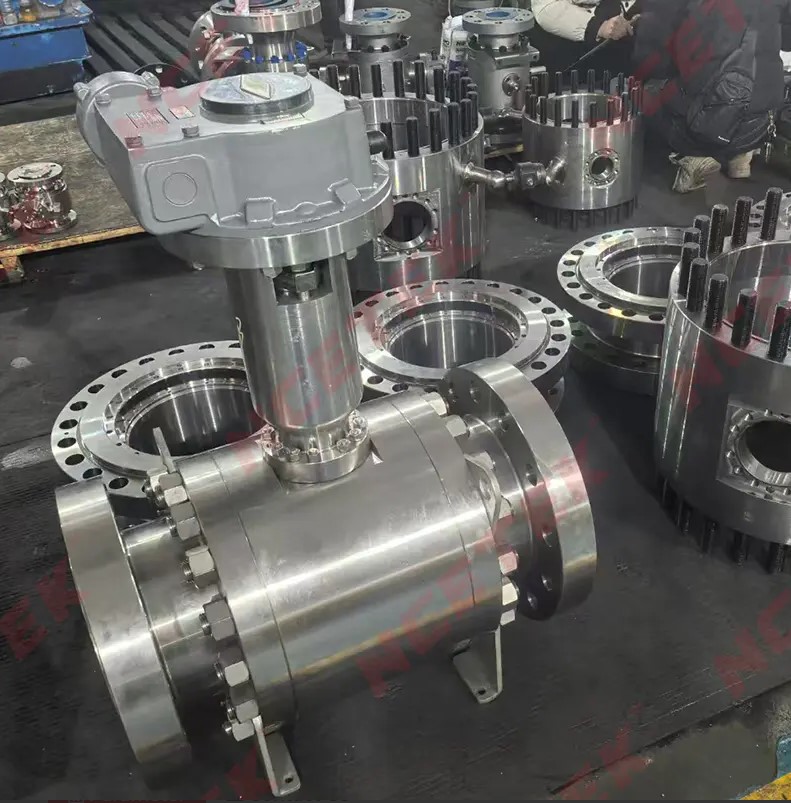
In actual pipeline systems, a High Pressure Three Way Valve is expected to shift flow direction with a smooth and repeatable motion. When everything runs normally, the internal rotating part moves through defined positions without noticeable hesitation. In practice, a different situation sometimes appears. The handle or actuator starts to feel heavier, movement slows down, then rotation stops at a certain angle and refuses to continue.
This kind of behavior is usually described as sticking in one position. It does not always mean the valve is completely locked. Some cases still allow slight movement, yet switching between flow paths becomes unreliable. Operators often notice that force increases without corresponding movement, which signals internal resistance building up inside the structure.
Inside a Three Way Ball Valve Factory design environment, motion stability is treated as a balance between structure, sealing contact, and pressure response. Once the valve is placed into a real system, external conditions begin to interact with that balance. Pressure changes, fluid condition, and installation stress gradually shape how the valve behaves during operation cycles.
Sticking is rarely linked to one isolated point. It usually develops through combined resistance inside and outside the valve body, where small changes accumulate until movement is affected.
In many field cases, movement resistance begins when pressure inside the system becomes uneven across different sections of the valve. A High Pressure Three Way Valve relies on controlled sealing contact between moving surfaces. Under balanced conditions, the sealing rings maintain contact without excessive force.
When pressure difference increases between the valve chamber and connected pipeline sections, the situation changes. The sealing surfaces are pushed harder against the rotating ball or spool. Contact pressure rises beyond normal operating range, and friction increases directly in the rotation path.
At this stage, movement does not fail immediately. Instead, rotation starts to feel heavier. The actuator may still respond, yet requires noticeably more force to move through switching positions. In some cases, the valve pauses near mid-position, where pressure load is uneven across internal surfaces.
When pressure imbalance continues over repeated cycles, sealing surfaces may gradually mark or polish unevenly. That change further increases friction, which makes movement recovery harder over time.
Pipeline systems carrying fluid over long periods often bring small solid materials along with the flow. Rust fragments, welding residue, and mineral scale are common in real environments, especially where maintenance intervals are long or fluid filtration is limited.
Inside a High Pressure Three Way Valve, internal clearance between moving components is narrow. Once particles enter this space, they do not simply pass through. Instead, they may become trapped between sealing surfaces and rotating elements.
In practical operation, this condition often develops quietly. At the beginning, movement may feel slightly uneven but still functional. As more particles accumulate, resistance appears at specific rotation points, especially during directional switching.
Particle accumulation does not always block movement completely. More often, it creates irregular contact points that disturb smooth rotation, especially under high pressure conditions where surfaces are already tightly engaged.
Not all internal blockage comes from solid debris. In many systems, fluid condition changes over time, leading to soft residue forming inside the valve body. This residue may come from degraded fluid, mixed impurities, or long-term chemical reaction inside the pipeline.
Unlike hard particles, sludge behaves differently. It spreads across internal surfaces, forming a thin but sticky layer that gradually builds up. Once this layer becomes thick enough, movement inside the valve feels less smooth even when no visible particles are present.
In operation, sludge-related resistance often shows up after long running periods or during restart after idle time. The first movement may feel heavier, then gradually improve once motion continues, although full smoothness may not return.
Over time, sludge can combine with small particles, forming mixed deposits that increase internal friction even further.
Inside rotating valve structures, lubrication is expected to reduce friction between contact surfaces. Under stable conditions, grease forms a thin layer that supports smooth movement between sealing and rotating components.
In real operation environments, lubrication condition changes gradually. High temperature exposure, long idle periods, or repeated cycling can alter grease behavior. Instead of remaining flexible, grease may dry out or harden in certain areas.
Once this happens, movement resistance increases noticeably at the start of rotation. After the valve begins moving, resistance may reduce slightly, yet initial force remains higher than expected.
In field conditions, lubrication issues are often mistaken for mechanical failure at first, although the root cause lies in surface condition rather than structural damage.
Sealing seats inside a High Pressure Three Way Valve maintain controlled contact with the rotating element. Under normal conditions, they provide balance between sealing and movement. When material condition changes, this balance may shift.
Exposure to corrosive fluid or temperature variation may cause seat material to expand or deform slightly. Once deformation begins, internal clearance reduces. Contact pressure between sealing surfaces increases beyond intended range.
This creates a direct impact on movement, since rotation must pass through tighter contact points. Resistance becomes more noticeable near switching positions, where sealing contact is strongest.
In many cases, this condition develops slowly, making early detection difficult during normal operation checks.
Installation conditions can introduce continuous external force into the valve body. When pipeline alignment does not match valve connection points, mechanical stress is transferred directly into internal components.
A High Pressure Three Way Valve relies on balanced structure to maintain smooth rotation. External force changes that balance, pressing internal parts slightly off-center. Over time, this misalignment affects how the rotating element moves inside the chamber.
Incorrect application of mixing or diverting flow patterns can also create flow imbalance inside the system. When flow direction does not match intended design behavior, internal pressure distribution becomes uneven, increasing resistance during switching.
| Cause Category | Field Condition | Resulting Behavior |
|---|---|---|
| Pressure imbalance | Uneven load across valve body | Increased friction during switching |
| Solid particles | Rust or scale intrusion | Local blockage and surface wear |
| Sludge formation | Soft deposit buildup | Sticky resistance during movement |
| Lubrication loss | Hardened grease condition | High starting torque |
| Seat deformation | Material swelling or wear | Reduced internal clearance |
| Installation stress | Pipeline misalignment | Continuous structural resistance |
A High Pressure Three Way Valve rarely works under exactly the same condition for a long period of time. Flow changes, pressure shifts, and repeated switching all leave small marks on the way the valve moves. At the beginning, rotation may feel smooth and easy. After a longer run, the same movement can start to feel tighter at certain points.
That change usually builds slowly. Sealing surfaces carry load every time the valve changes position. The wear may be small at each cycle, yet it keeps adding up. Once the contact surface becomes less smooth, the effort needed to move through the switching range also changes.
The change is gradual enough that it can be missed at the beginning. Once noticed, it often means the valve has already been under stress for some time.
The surrounding environment also shapes how the valve behaves. Temperature changes, vibration from nearby equipment, and shifts in fluid condition can all affect movement inside the valve body.
When temperature rises or drops, internal parts may expand or contract slightly. That small change can alter the contact between sealing surfaces and moving parts. Vibration adds another layer of influence. A pipeline that stays under constant low-level vibration may slowly lose alignment, which then affects how the valve turns.
Fluid condition matters as well. A change in flow texture, residue, or internal cleanliness may not stop movement at once, yet it can make the valve feel less steady during switching.
These conditions often work together rather than alone. That is why movement problems can appear slowly even when the valve itself has not been damaged in an obvious way.
Wear inside the valve does not happen evenly. Some contact points carry more load than others, depending on flow direction and switching pattern. Over time, those areas begin to show more resistance than the rest of the surface.
At the beginning, the change may be small. Movement still happens, yet one part of the rotation feels slightly heavier than another. As wear continues, the difference becomes easier to notice. The turning path loses part of its smooth feel, and the valve may pause near certain positions.
Once wear joins with pressure imbalance or residue buildup, sticking becomes easier to trigger.
The way a valve is built has a direct effect on how it behaves in the field. Internal shape, surface finish, sealing contact, and component alignment all influence how smoothly the valve moves after installation.
A Three Way Ball Valve Factory has to keep these details consistent during production, since even small changes in internal spacing or surface contact can change how the valve responds under pressure. When the structure is balanced, movement stays more predictable. When the internal fit is uneven, system conditions can create more resistance during switching.
These design choices do not remove operating stress, yet they help the valve handle it in a steadier way over time.
In real systems, sticking usually comes from several conditions working together. A pressure difference may press the sealing surfaces harder than expected. At the same time, small particles or soft deposits may reduce the available clearance. If lubrication has also weakened, movement becomes harder again.
When several of these conditions appear together, the valve may stop at one position or need much more force to move out of it.
Field behavior often shows that sticking does not appear at random. Certain points in the operation cycle reveal resistance more clearly.
These are the points where internal balance changes quickly. If the valve already carries some resistance inside, the problem becomes much easier to notice there.
Before full sticking appears, the valve usually gives small signs. The changes may be easy to ignore at the start, especially when the system still keeps running.
When these signs show up together, the valve is often moving away from normal behavior and toward higher resistance.
Movement stability in a High Pressure Three Way Valve depends on pressure balance, surface condition, fluid cleanliness, installation fit, and repeated operating load. When these parts stay in line, switching remains smoother. When several of them start changing at the same time, resistance builds little by little until the valve begins to stick in one position.
In many field systems, the problem is not caused by a single fault. It comes from a set of small changes that accumulate over time. That is why the working condition of the whole system matters as much as the valve body itself.
 nce@cnnsv.com
 +86-15727968392 / +86-15397375798
 +86-577-67091815
 +86-577-67091815
 Dongou Industrial Zone, Oubei Street, Yongjia County, Wenzhou City, Zhejiang Province, China


Contact Us