
 русский
 简体中文
简体中文

Cryogenic Ball Valve Design is specialized quarter-turn shutoff devices engineered to handle extremely cold fluids reliably. These fluids—liquefied natural gas, liquid nitrogen, liquid oxygen, liquid argon, and others—only remain liquid at very low temperatures.
In such conditions, ordinary valves quickly develop problems:
The goal of a cryogenic ball valve design is simple but demanding: provide tight, repeatable shutoff and smooth operation despite repeated thermal cycling, contraction, potential pressure buildup from trapped fluid, and the constant risk of external ice formation.
These valves appear in:
Standard ball valves work well for water, oil, steam, or chemicals at ambient or moderately elevated temperatures. Drop the temperature dramatically and the same valve can become unreliable or unsafe.
Metals contract when cooled. Different parts (body, ball, stem, seats) may shrink at slightly different rates depending on exact alloy and geometry. This creates tiny misalignments that, over many cool-down and warm-up cycles, can cause increased operating torque, uneven seat contact, or micro-leaks.
Sealing materials that are soft and compliant at room temperature often turn rigid and glassy in the cold, losing their ability to seal against microscopic surface imperfections on the ball. Ordinary lubricants become viscous or solidify, making the valve hard to turn by hand or overloading actuators.
External moisture in the air freezes on any cold surface, forming ice that can lock handles, seize stem bearings, or hide small leaks until pressure builds dangerously.
A poorly designed valve in these conditions can lead to:
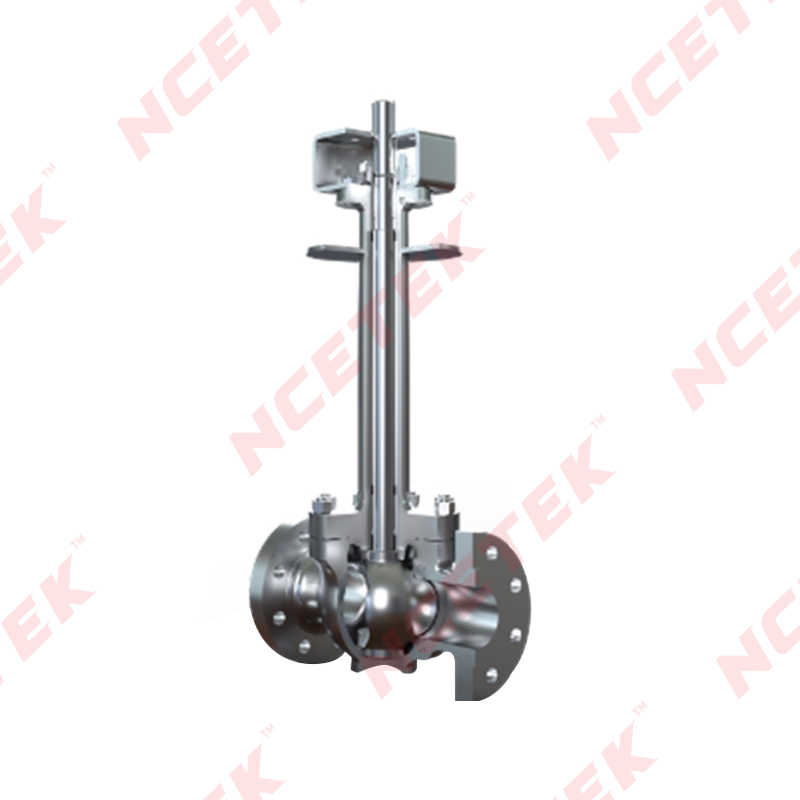
Manufacturers therefore incorporate several purposeful design changes. The most visible is the extended bonnet (also called extended stem or long-neck design). This lengthens the distance between the cold valve body and the stem packing / gland area. A column of vaporized gas naturally forms inside the extension, acting as a thermal barrier. This keeps the packing zone much closer to ambient temperature so seals remain flexible and ice does not form around the stem. The extension also makes it easier to wrap insulation around the valve and provides clearance for manual operation or actuator mounting outside insulated cold boxes.
Other important adaptations include:
These features collectively allow the valve to cycle reliably through thousands of operations while exposed to repeated temperature swings.
At its core, a cryogenic ball valve follows the same principle as any floating or trunnion-mounted ball valve. A spherical ball with a bore through its center rotates 90 degrees inside the valve body. When the bore aligns with the inlet and outlet ports, flow passes straight through with very low pressure drop. When rotated perpendicular, the solid portions of the ball block the ports, providing shutoff.
What sets the cryogenic version apart is how every component is adapted:
Body — Usually forged or cast from austenitic stainless steels chosen for excellent low-temperature impact toughness. Common choices include grades that do not transition to brittle behavior in the cold.
Ball — Often trunnion-mounted in larger sizes for stability under differential pressure and thermal stress. Some designs include a relief hole on the upstream side to prevent overpressure if liquid is trapped and warms.
Seats — Critical for tight shutoff. Materials must remain somewhat compliant in the cold. Special polymers or composites are common because they resist embrittlement better than standard elastomers. Seats are frequently spring-loaded so they continue pressing against the ball even as dimensions change.
Stem — One-piece, anti-blowout construction is standard. The stem connects to the ball in a way that maintains orientation and prevents twisting under torque.
Bonnet / Extension — The extended bonnet is usually the defining visual feature. Its length creates the vapor space mentioned earlier. The packing (gland seals) sits high up near ambient conditions. This design reduces heat leak into the cold fluid and prevents the packing from freezing.
Operation remains a simple 90-degree turn, but torque is often higher than a standard valve due to thicker lubricants, stiffer seats, and contraction effects. For this reason, many cryogenic ball valves are equipped with manual gear operators or pneumatic/electric actuators sized generously for cold conditions.
Because the valve is quarter-turn, it offers fast action—important in emergency isolation scenarios common in LNG transfer or air separation plants.
Understanding the physics helps explain why cryogenic designs look the way they do.
These effects combine to make operation more demanding than in ambient service. Operators learn to move valves slowly during cooldown or warmup phases to minimize thermal shock and differential contraction stresses.
Cryogenic ball valves appear wherever cryogenic fluids must be isolated, directed, or throttled reliably.
Examples include:
In all these settings, the valve's primary jobs are:
Cryogenic service is unforgiving—small operator errors can snowball.
Even well-designed valves need attention.
Routine Visual Checks
Periodic Functional Checks
Overhaul Considerations
Manufacturers often supply detailed IOM (Installation, Operation, Maintenance) manuals specific to their cryogenic models. Following these is critical.
Often yes, provided the body/trim materials are compatible and the valve was cleaned to the strictest service level.
Visual checks during every major shutdown or turnaround. Full internal inspection intervals depend on cycle count, criticality, and operating experience.
Rising torque, uneven or unexpected frost, slight external weeping, slower closing/opening, or unusual noise/grinding during operation.
Special materials, extended bonnet fabrication, precision machining for clearances, spring-energized seats, clean-room assembly, and rigorous low-temperature testing add cost—but improve long-term reliability.
Cryogenic ball valves may appear as just another industrial valve, but they represent a careful balance of materials science, thermal engineering, and practical field experience.
The extended bonnet alone solves multiple problems at once: protecting seals, enabling insulation, reducing heat leak, and improving accessibility.
When correctly specified, installed, operated slowly and deliberately, and inspected regularly, these valves deliver years of dependable service in environments where failure is not an option. They quietly support:
Key Takeaways
In low-temperature systems, a good cryogenic ball valve is not just a component—it is a safety and reliability cornerstone.
 nce@cnnsv.com
 +86-15727968392 / +86-15397375798
 +86-577-67091815
 +86-577-67091815
 Dongou Industrial Zone, Oubei Street, Yongjia County, Wenzhou City, Zhejiang Province, China


Contact Us