
 русский
 简体中文
简体中文

A Buried Ball Valve operates in an environment where direct access becomes difficult after installation. Soil can remain in contact with the outer surface for long periods, while moisture around the buried structure can create conditions that encourage corrosion when exposed metal is present.
External coating provides a protective barrier between the metal surface and the surrounding environment. A coating can appear intact during a visual check while still containing a tiny hole, crack, thin spot, or other discontinuity that is difficult to see. Electrical holiday testing is intended to locate such discontinuities in non‑conductive coatings applied over conductive metal surfaces.
For an underground valve, inspection before burial has a practical advantage. Once soil covers the valve, access to the external surface becomes restricted. Repairing a small coating defect at that stage can require additional excavation and work around the installed pipeline.
Coating inspection therefore takes place before the valve moves into its buried operating position. A spark tester does not judge every property of a coating. Electrical testing is intended to identify discontinuities rather than determine coating adhesion, service life, or overall film quality.
A high‑voltage spark tester works through the electrical difference between the conductive metal body and the non‑conductive coating. An electrode moves across the coated surface while the metal substrate is connected to the grounding system.
When coating coverage remains continuous, the electrical path between the electrode and metal body is interrupted by the insulating layer. A discontinuity changes that condition. At a defect, the electrical path can cross the exposed or insufficiently protected area, producing a spark or an alarm from the testing equipment.
Small defects can occur around curved areas, edges, connections, coating transitions, and other sections where application conditions are less uniform. A careful inspection moves the electrode across the accessible coated surface so potential problem areas are not overlooked.
Testing should not be treated as a simple pass or fail action based only on whether a spark appears. Surface condition, coating properties, grounding, equipment operation, and test settings all affect the result.
A coating that has not cured properly may behave differently during electrical inspection. Moisture or surface contamination can influence readings as well, so the coated surface needs suitable preparation before testing.
A 20kV setting should not be treated as a universal requirement for every Buried Ball Valve. Suitable test voltage depends on characteristics of the coating system, including its thickness and electrical properties. Current guidance emphasizes selecting voltage according to the coating being inspected rather than applying one fixed value to every situation.
Too little electrical energy may fail to reveal a discontinuity. Excessive voltage can create a defect in a coating that was previously sound, which makes voltage selection an important part of the inspection process.
For that reason, the coating requirements should be established before testing begins. A suitable working approach considers:
A stated voltage on a test procedure should therefore be connected with the actual coating system rather than treated as a fixed value simply because a valve is intended for underground installation.
Preparation has a direct influence on electrical inspection. Coating needs sufficient curing before a high‑voltage test is performed, since residual solvents or an incompletely cured surface can affect test behavior and produce unreliable indications.
Surface cleanliness matters as well. Water, dirt, oil, or other residue can interfere with contact between the electrode and coating surface. A clean and suitably dry surface makes it easier to distinguish an actual coating discontinuity from an indication caused by surface conditions.
Equipment condition requires attention before inspection. Grounding should be properly connected, while the tester should be checked according to its operating requirements. Current guidance also calls for verification of test voltage and equipment operation under relevant testing conditions.
For a valve prepared for underground service, careful preparation makes the inspection more meaningful. A coating defect can then be located and marked while the entire outer surface remains accessible for repair.
A spark or alarm during inspection indicates that an area needs closer attention. Such an indication does not automatically mean that the valve body has been damaged. Electrical testing is aimed at locating discontinuities within a non‑conductive coating, so the next step is to identify the exact position and inspect the surrounding surface.
Once a suspected defect is located, marking the area helps keep the repair process organized. Coating repair should follow the requirements established for the particular coating system, since surface preparation and repair material can affect how well the repaired section connects with the surrounding coating.
Repair work normally focuses on restoring continuous protection around the affected area. Loose coating, contamination, or other material that could interfere with repair needs to be addressed before new coating is applied.
After repair, another inspection may be appropriate to confirm that the repaired area no longer presents the original discontinuity. Rechecking repaired sections is particularly useful before burial because access remains available and any remaining problem can be addressed without disturbing the surrounding ground.
A useful distinction needs to remain clear:
AMPP guidance describes holiday testing as a method for detecting discontinuities in new non‑conductive coatings applied to conductive substrates, rather than as a general assessment of every coating property.
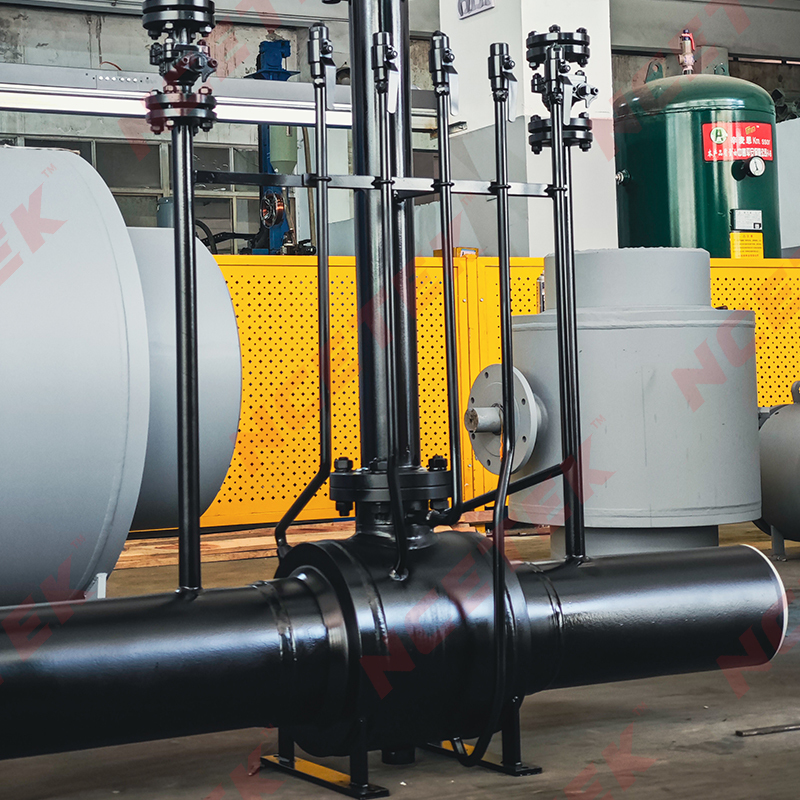
For a Fully Welded Ball Valve Supplier, coating inspection needs to fit into the wider preparation and quality‑control process. A buried valve involves several separate concerns, including body construction, sealing performance, weld condition, external protection, and preparation for installation. Each inspection method addresses a different condition.
Coating inspection requires access to the external surface, so testing is easier before the valve reaches its final underground position. Surface preparation, coating curing, grounding, test equipment, and electrode selection all need to be considered before inspection begins.
A supplier handling coated valves may need to pay particular attention to areas that are difficult to reach with an electrode. Curved surfaces, edges, transitions, and connections can require careful electrode movement so the inspection covers the intended coated area. Current guidance calls for the electrode to contact the area being inspected and for the inspection process to cover the full designated surface.
Equipment verification forms another part of the process. Grounding needs to provide a reliable electrical connection with the conductive substrate, while test voltage should be verified under the applicable inspection conditions. Equipment operation should be checked when relevant conditions change, such as a change in electrode or coating.
Burial changes the accessibility of an external valve surface. Once surrounding soil has been placed around the equipment, inspection and repair become more difficult because much of the coating can no longer be reached directly.
Pre‑burial inspection provides an opportunity to locate discontinuities while the coated surface remains visible and accessible. A defect can be marked, repaired, and checked again before installation proceeds.
| Inspection Stage | Main Concern | Practical Purpose |
|---|---|---|
| Surface Preparation | Dirt or moisture | Reduce misleading indications |
| Coating Condition | Sufficient curing | Support reliable testing |
| Grounding | Electrical connection | Complete the test circuit |
| Voltage Setting | Match coating conditions | Avoid missed defects or coating damage |
| Surface Scanning | Full intended coverage | Locate discontinuities |
| Repair Check | Repaired coating | Confirm the affected area has been addressed |
A stated voltage such as 20 kV should therefore be viewed in relation to the coating rather than as a universal requirement for every Buried Ball Valve. Current guidance indicates that test voltage should take coating characteristics and measured coating thickness into account, while excessive voltage can damage the coating.
Spark testing has a focused purpose: locating discontinuities in a non‑conductive protective layer over a conductive metal surface. It does not replace other checks related to valve construction, sealing, welding, or mechanical condition. Keeping each inspection method connected to its intended purpose allows coating problems to be addressed before the valve becomes difficult to access underground.
 nce@cnnsv.com
 +86-15727968392 / +86-15397375798
 +86-577-67091815
 +86-577-67091815
 Dongou Industrial Zone, Oubei Street, Yongjia County, Wenzhou City, Zhejiang Province, China


Contact Us