
 русский
 简体中文

A valve holds tight for weeks. The handle turns smoothly, and the body looks fine. Then a line that heats and cools every shift starts to weep at shutoff, and nobody can point to a damaged part. The cause often sits in how the components behaved over many cycles, not in any single failure.
A Heat Resistant Ball Valve is built for hot service, but heat resistance does not mean every part reacts the same way. The body, ball, seats, and seals expand and recover at different rates. Below is a practical look at why leakage appears, what to inspect, and what to ask before buying.
A ball valve seals when the seats press against the ball in the closed position. That seal depends on the ball staying in place, the seats keeping contact, and the sealing materials holding their shape and flexibility. Temperature changes touch all three.
Metal parts grow as they heat and shrink as they cool. Seats often use a different material, so the fit between ball, body, and seats shifts. The effect may be brief, or it may leave lasting damage after many cycles. A seat that has deformed may not return to its original shape, so leakage can persist even after the valve is back at normal temperature.
| Possible Cause | Effect on the Valve | Leakage Concern |
|---|---|---|
| Uneven thermal expansion | Changes the fit between parts | Seat contact becomes uneven |
| Loss of sealing force | Reduces contact with the ball | Fluid passes the closed valve |
| Seat deformation | Alters the seat's original shape | A consistent seal becomes hard |
| Material aging | Changes flexibility or surface | Sealing declines over time |
| Installation stress | Distorts the valve or connections | Contact around the ball varies |
These causes often overlap. A valve may move with temperature while its seats are also stiffening, so the combined effect shows up sooner.
If the ball grows more than the surrounding structure, seat contact tightens. That can raise turning effort and stress the seating surface, which then wears or deforms faster. If the surroundings change shape so that contact drops, the seal weakens and a small gap opens. After cooling, parts may return close to their original size while the seats do not, so the fit slowly drifts from the design.
Preload is the contact force built in when the seats are assembled. Too little and the seat does not seal evenly. Too much and friction rises, which speeds wear. Heating and cooling change the force acting between parts, so a design that seals in one condition may behave differently in another.
| Preload Condition | Possible Behavior | Concern |
|---|---|---|
| Insufficient force | Seat seals unevenly | Leakage through the closed valve |
| Excessive force | Friction and stress rise | Faster wear or deformation |
| Changing force | Sealing varies with temperature | Leakage at certain stages |
| Uneven contact | Pressure not spread evenly | Localized seat damage |
Adding preload is not an automatic fix. If the real cause is thermal distortion, damaged material, or poor alignment, more force adds stress without solving anything.
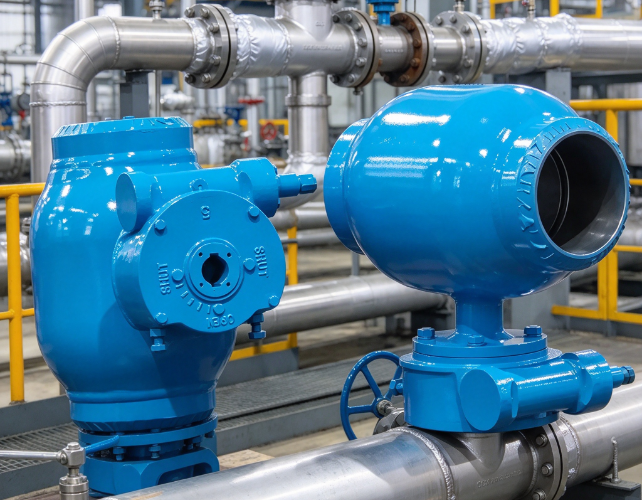
Some seat materials rely on flexibility to follow small ball movements. Repeated heating can make them stiffer or more prone to deformation. Others hold shape but adapt less to dimensional change. Chemical compatibility counts too, because the process fluid can alter a seat's surface over time, and heat speeds that up.
Think of the valve as a material pairing. The ball surface must stay compatible with the seat, and the seat must keep enough resilience for the movement in service. Scratches or deposits on the ball can stop even a suitable seat from sealing evenly. The words "heat resistant" describe one design goal, not proof that every seat suits every hot fluid.
Not every leak comes from the ball and seats. As the body heats and cools, a rigid pipeline can load the connections, and poor alignment adds stress. Stem seals can also lose flexibility, letting fluid escape around the stem instead of through the closed ball. Joint leakage is sometimes mistaken for internal leakage, so check the outside of the valve first. Correct alignment and suitable support reduce needless stress.
Operation matters as well. Rapid heating or cooling can leave one area hotter than another, and the uneven movement raises stress. Turning the ball against deposits can scratch the seating surface. Leaving a valve not meant for throttling partly open for long periods exposes the seats to conditions unlike normal shutoff. Follow the manufacturer's instructions and keep temperature changes controlled where the process allows.
Deposits and particles can also block contact between ball and seat, so a valve may leak because of contamination instead of expansion.
Leakage pattern gives clues. Leakage mainly during temperature changes points toward expansion and seat contact. Leakage that continues once conditions settle suggests permanent seat damage or another mechanical problem. A handle that gets harder to turn may signal friction, contamination, or changed internal contact, though resistance alone does not confirm the source.
Ask these questions during inspection:
Before any inspection, isolate the valve and make it safe by the site procedure. Hot fluid and trapped pressure are real hazards, and a valve should not be opened while exposed to them. Then examine the ball, seats, stem seals, and connections for scratches, deformation, hardening, deposits, and corrosion, and decide on repair or replacement per the valve design.
Records help. If a valve leaks after similar cycles each time, the pattern may point to material choice, temperature pattern, or installation stress. Clean and lubricate only where the design and fluid allow, since an unsuitable lubricant can damage seals or contaminate the process.
Describe the temperature pattern to the supplier. Gradual, predictable heating asks less of a valve than frequent or rapid swings. Identify the fluid, its pressure, and any tendency to carry particles or form deposits. Review connection design and the installation environment for alignment, pipe movement, and outside loads.
Useful questions for the supplier:
Clear answers show whether the valve fits the actual application instead of just the product category. Long-term sealing in a Heat Resistant Ball Valve rests on expansion behavior, seat preload, material compatibility, surface condition, and installation. Checking them together gives maintenance teams a more orderly way to trace leakage and choose a valve that suits the process.
 nce@cnnsv.com
 +86-15727968392 / +86-15397375798
 +86-577-67091815
 +86-577-67091815
 Dongou Industrial Zone, Oubei Street, Yongjia County, Wenzhou City, Zhejiang Province, China


Contact Us