
 русский
 简体中文

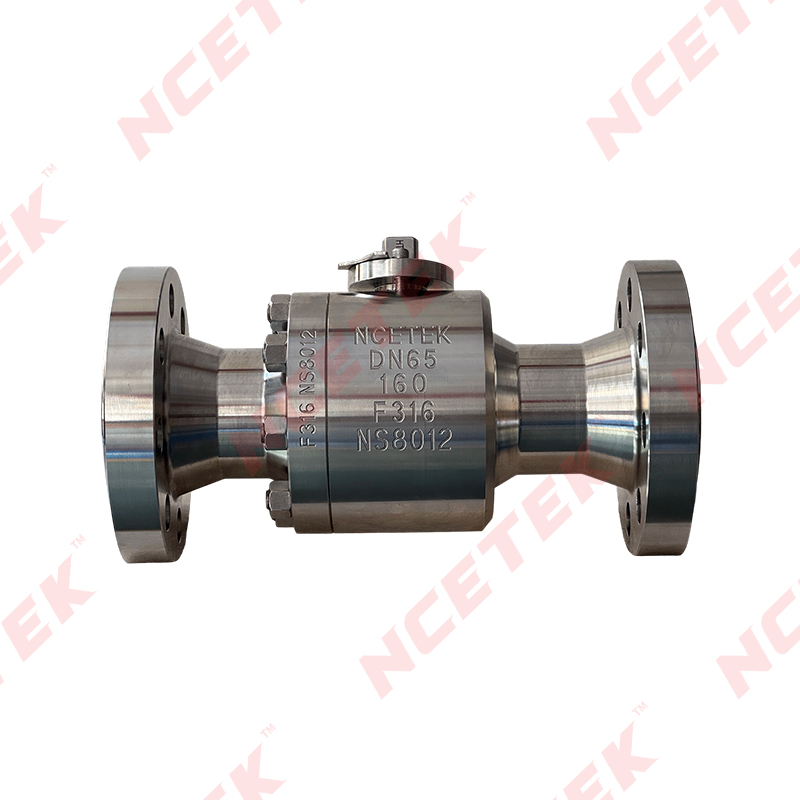
Picture an operator at a plant standing beside a valve that no longer turns smoothly. The actuator strains, the stroke time drifts, and the maintenance log fills with notes about the same line. A Metal Seat Ball Valve has to hold shutoff in hot, abrasive, or high-pressure service, and the metal-to-metal contact that makes this possible also creates friction. Lowering torque means working on ball-to-seat contact, surface condition, seat preload, valve structure, and real process conditions together, without weakening the seal.
Operating torque is the rotational force needed to move the ball between open and closed positions. In a Metal Seat Ball Valve, it comes from the interaction of the ball, seats, stem, bearings, and process pressure. Soft seats yield and lubricate the contact. Metal seats do not, so friction has to be managed through design.
The sliding contact between the ball and seats is a major source of resistance. Several conditions raise it:
Poor surface matching also concentrates load on small contact points instead of spreading it across a consistent sealing band.
Preload keeps the seats against the ball, which helps shutoff when line pressure is too low to do it alone. Too much preload adds friction on every turn. Spring-loaded seats need careful engineering because the spring affects both sealing and torque.
Review spring stiffness and compression, seat travel, contact force at different pressures, thermal expansion, and the sealing load actually needed. Cutting preload without checking these points can cause internal leakage, so the goal is balance.
Differential pressure changes the forces on ball and seats and, depending on construction and flow direction, can raise or redistribute contact loads. Temperature matters because metals expand at different rates. Clearances, spring compression, and bearing movement all shift. A valve that turns easily at room temperature may behave differently on a hot line, so torque should be assessed at working conditions.
Each measure below targets a different source of resistance.
An unsuitable profile concentrates pressure in small zones, which raises friction and speeds wear. Review the contact profile, pressure distribution, seat alignment, and tolerances. Confirm that the sealing band holds across the operating range and that the change opens no leakage path. Shrinking the contact area is not the aim, because a very small area raises local stress and damages the surfaces.
Hard-facing improves resistance to abrasion and erosion, but a harder surface does not automatically mean lower friction. Look at the pair as a whole.
| Surface Factor | Effect on Operation |
|---|---|
| Hardness | Resistance to wear and deformation |
| Roughness | Friction at the contact |
| Coating adhesion | Surface integrity during cycling |
| Material pairing | Friction and contact behavior |
| Thermal stability | Performance as temperature changes |
| Coating thickness | Dimensional accuracy and clearance |
Thermal spraying and hard alloy overlays are common routes. The right choice depends on medium, temperature, pressure, and the wear mechanism expected. Selecting ball and seat coatings separately can produce a friction pair nobody tested.
An overly strong spring raises friction, and a weak one cannot hold the seal. Check material, stiffness, installed compression, seat movement during pressure changes, and thermal growth. In hot service, also consider spring relaxation over repeated cycles.
Machining irregularities and inconsistent finishing create local friction and uneven contact patterns. Focus on precise ball machining, controlled grinding and lapping, consistent finish, accurate seat alignment, and dimensional inspection before assembly. Lapping helps the ball and seat match closely. Inspect the finished parts themselves, since machine settings do not guarantee the surface that results.
Floating and trunnion designs support the ball differently, so torque behaves differently.
| Aspect | Floating Ball | Trunnion Mounted |
|---|---|---|
| Ball support | Ball shifts under pressure in the seats | Ball held by upper and lower trunnions |
| Pressure loading | Can raise seat contact force | Loads carried through the trunnion |
| Torque influences | Pressure and seat loading | Bearings, seat loading, support design |
A trunnion design can help where ball support and pressure loading need control. Neither style guarantees low torque, so seat design, bearing friction, and sealing needs still decide the result.
A valve in a clean utility line sees different resistance than one handling abrasive slurry, viscous fluid, or hot process media. Separating design-related torque from process-related torque helps target the right fix.
Pressure differential, flow direction, and startup and shutdown pressure swings all change contact forces. Base torque calculations on the real specification, not a convenient assumption.
Fluid properties count too. Abrasive particles damage sealing surfaces, and deposits interfere with ball movement. Evaluate chemical compatibility, erosion resistance, solids content, thermal expansion, and friction changes over repeated use.
Sizing matters as well. Choose by process flow and pressure needs, not only pipeline diameter, so the valve works within its intended range.
A calculated reduction in friction does not prove better performance after assembly, so test the finished valve.
| Torque Type | Meaning | Significance |
|---|---|---|
| Breakaway | Force to start ball rotation | Resistance at the start of movement |
| Running | Force during rotation | Resistance in continuous travel |
| Reseating | Force as the valve returns to closed | Closing and sealing behavior |
| End-to-end | Force near the end of stroke | Actuator selection |
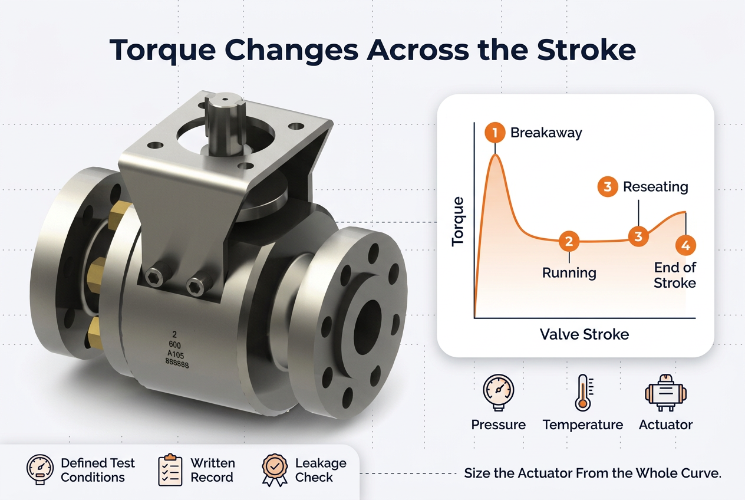
A practical test sequence:
Compare results before and after design changes. Never accept a lower torque without confirming that sealing is intact.
Actuator selection follows from these results. An undersized actuator may not finish the stroke, and an oversized one adds cost and mechanical load. Consider torque across the stroke, pressure and temperature, power or air supply, cycle frequency, and a reasonable engineering margin. Position feedback, actuator diagnostics, and operating records also help maintenance teams notice rising torque, which may point to seat wear, contamination, bearing resistance, or changed process conditions.
Low torque should sit within the full performance requirement, alongside sealing and manageable actuator loads.
Give the supplier the information needed for a sound recommendation: valve size and rating, operating and differential pressure, temperature, fluid characteristics, cycle frequency, and actuator requirements.
Reducing torque is a coordinated task across geometry, sealing surfaces, manufacturing precision, and process conditions. Teams dealing with high torque, actuator mismatch, or inconsistent operation can share their application data with our engineers and request a technical evaluation of their Metal Seat Ball Valve requirements.
 nce@cnnsv.com
 +86-15727968392 / +86-15397375798
 +86-577-67091815
 +86-577-67091815
 Dongou Industrial Zone, Oubei Street, Yongjia County, Wenzhou City, Zhejiang Province, China


Contact Us