
 русский
 简体中文

In industrial process systems, some valves stay in one position for long periods, while others open and close repeatedly as operating conditions change. Repeated movement places different demands on a valve, especially when it handles hot fluids or sits close to heated equipment. A valve that performs adequately under occasional operation may respond differently once cycling becomes part of the normal routine.
A High Temperature Ball Valve should be judged as a complete operating assembly. The body, ball, seats, stem, seals, and actuator all influence how it handles repeated movement under heat. A Heat Resistant Ball Valve may suit hot service, but heat resistance alone does not show that a valve will hold up to frequent cycling. The evaluation has to reflect the real process, including temperature changes, pressure, fluid properties, and the expected pattern of opening and closing.
A ball valve turns a drilled ball to align with the pipeline or block it. Every turn moves the ball against the seats and loads the stem and its bearings. Over many cycles, contact surfaces and seals can wear, collect deposits, or change shape. Heat adds another layer, since different parts expand at different rates and can alter clearances.
A valve used for routine flow adjustment sees a different movement pattern from one that operates only at startup, shutdown, or isolation. The number of cycles and the nature of each cycle both matter. A steam line that is isolated twice a day places different demands on a valve from a heated batch line that switches every few minutes.
| Evaluation Area | Why It Matters in Frequent Cycling |
|---|---|
| Thermal conditions | Heat affects component dimensions and behavior |
| Sealing performance | Repeated contact influences leakage control |
| Operating torque | Movement must stay within actuator capability |
| Stem and bearing areas | Repeated rotation causes wear |
| Actuator control | Inconsistent motion affects process response |
| Maintenance access | Service must be practical in the plant layout |
The purpose is not simply to find a valve that tolerates heat. It is to learn whether the whole assembly keeps performing over repeated cycles without unacceptable leakage, sticking, or maintenance demands.
Temperature exposure is not always constant. Some systems stay hot during normal operation, while others move between heated and cooler states. A kitchen pan shows the idea: repeated heating and cooling stresses the metal, and the handle, lid, and base respond in different ways. In a valve, the body, ball, stem, and seals expand and contract at different rates, which changes contact pressure and the effort needed to turn the ball.
Material selection should begin with the expected service conditions. The materials must suit the process fluid, the stated thermal conditions, the pressure, and any risk of corrosion or deposits on moving surfaces. A few practical questions help guide the review:
A body built for hot service may still carry seats or seals with different operating limits. These parts belong to the same system and must be assessed together. A Heat Resistant Ball Valve should therefore be selected on documented suitability for the complete application, including behavior during temperature transitions and not only after it reaches a stable state.
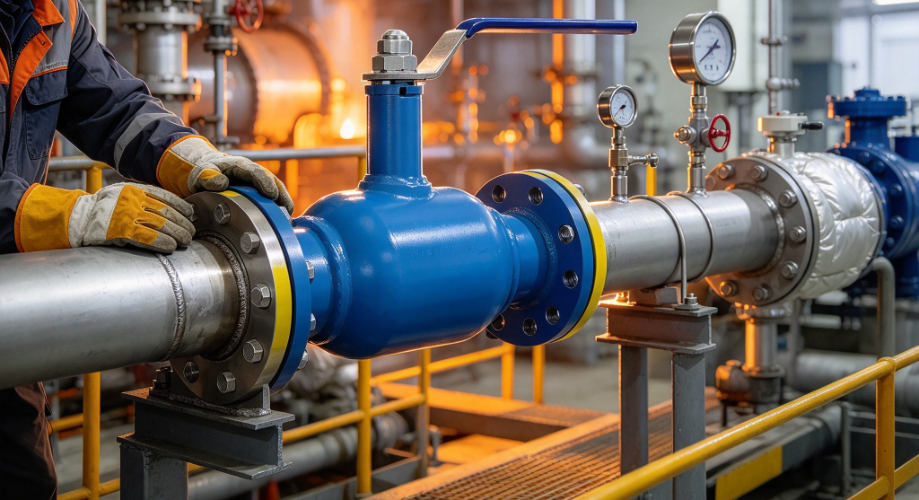
Each closure asks the ball and seats to meet again in the same way. Wear, contamination, deformation, or thermal movement can change that contact, and leakage behavior may change with it. Seat materials and designs respond differently to heat, so a choice that works in one process may fail in another.
Define the sealing duty first. Some systems need tight isolation when the valve is closed, while others use it mainly to start and stop flow. Once the duty is clear, review these points:
A valve that seals well on the bench can reveal problems after cycling, so include checks afterward. The test must also reflect the relevant configuration and service conditions, because a result obtained under different heat or pressure says little about the intended process.
If leakage develops, investigate before blaming the seat material. Contamination, incorrect installation, actuator travel errors, and changes in operating conditions can all affect closure.
Torque is the turning effort needed to move the ball through its travel. It affects manual operation and actuator selection. It can shift with temperature, pressure, seat contact, lubrication where applicable, and the condition of moving parts. A valve that turns smoothly when new may demand more effort after exposure to the real process environment.
| Factor | Evaluation Focus |
|---|---|
| Valve operating effort | Movement suits the service conditions |
| Thermal effects | Heat may change resistance to movement |
| Actuator capability | Suitable for the valve's requirements |
| Coupling and mounting | Motion transfers correctly |
| Travel control | Full open and closed positions are reached |
| Operating consistency | Movement stays repeatable |
An actuator should not be chosen only because it can move a new valve at room conditions. Expected operating conditions and changes over the service life also count.
If torque rises unexpectedly, adding actuator force hides the cause and stresses the assembly. Look for contamination, misalignment, internal wear, or an installation fault first. Finding the reason avoids unnecessary strain on the stem and ball.
The actuator turns a control signal or operator command into valve movement. Some processes need simple open-and-close action, while others respond to control signals in an automated sequence. Match the actuator type, mounting, and feedback method to that duty.
Before commissioning, verify the direction of movement, the end positions, the signal response, and any feedback sent to the control system. Poor travel settings can prevent full opening or closing. A signal that hovers around a switching point can make the valve cycle far more often than the process needs, and the fix then lies in the control logic instead of the valve.
Frequent cycling also makes access important. Actuators may need inspection or adjustment during service life, so leave room for safe work away from nearby pipes, insulation, and equipment.
A simple open-and-close check confirms movement but says little about behavior under heat. Build the test around the process: temperature exposure, pressure, fluid compatibility, sealing requirements, and the intended cycling pattern. A structured review can follow these steps:
A passing result applies only to the conditions actually tested. It does not cover every temperature, pressure, fluid, or cycling pattern. For demanding duties, the supplier and process engineer should agree on acceptance criteria beforehand instead of relying on vague claims about durability.
Pipe loads, misalignment, weak support, and interference from nearby equipment strain the body and operating mechanism. Frequent cycling makes these faults show sooner. Plan orientation, access, connection arrangement, and actuator clearance, and keep insulation from blocking inspection points.
Follow the manufacturer's instructions and the site safety procedures. Inspection can cover these areas:
Inspection frequency should reflect the process, the manufacturer's guidance, and the consequences of a failure. A valve in a demanding thermal environment needs a different approach from one in stable conditions.
When problems repeat, review the valve, actuator, controls, piping, and process conditions together. Replacing one part may leave the cause untouched. Clear records of symptoms, service conditions, and maintenance actions help the team decide whether the current High Temperature Ball Valve configuration still fits the application.
 nce@cnnsv.com
 +86-15727968392 / +86-15397375798
 +86-577-67091815
 +86-577-67091815
 Dongou Industrial Zone, Oubei Street, Yongjia County, Wenzhou City, Zhejiang Province, China


Contact Us